"We need more marketing." That sentence comes up in almost every intro call — and it's almost always the wrong diagnosis. Because it leaves open what's actually missing: hands that execute, or a head that decides what gets executed. Confuse the two and you buy the wrong model, then wonder twelve months later why nothing moved.
There are four options. They differ less in price than in what you actually get.
The four models side by side
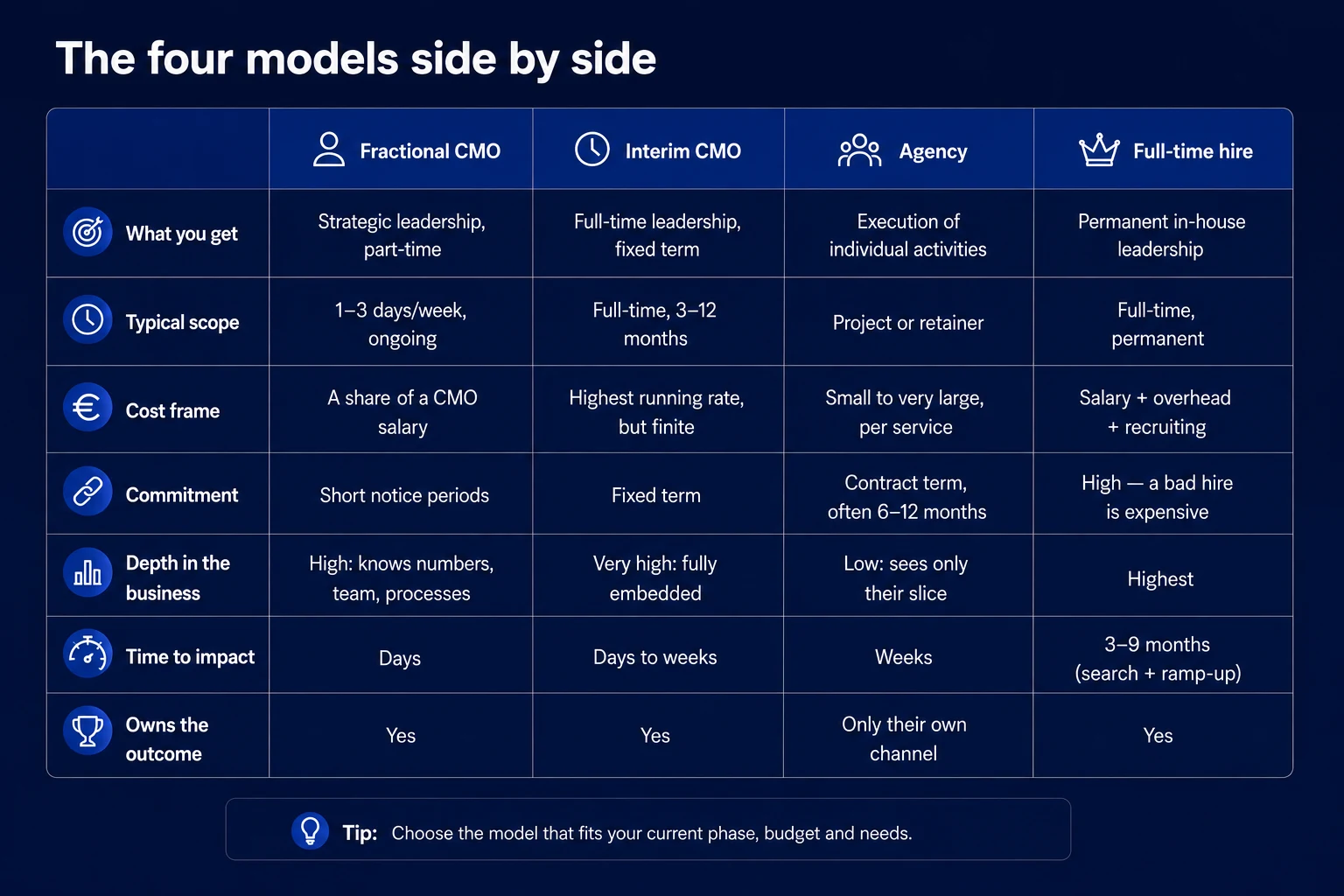
| Fractional CMO | Interim CMO | Agency | Full-time hire | |
|---|---|---|---|---|
| What you get | Strategic leadership, part-time | Full-time leadership, fixed term | Execution of individual activities | Permanent in-house leadership |
| Typical scope | 1–3 days/week, ongoing | Full-time, 3–12 months | Project or retainer | Full-time, permanent |
| Cost frame | A share of a CMO salary | Highest running rate, but finite | Small to very large, per service | Salary + overhead + recruiting |
| Commitment | Short notice periods | Fixed term | Contract term, often 6–12 months | High — a bad hire is expensive |
| Depth in the business | High: knows numbers, team, processes | Very high: fully embedded | Low: sees only their slice | Highest |
| Time to impact | Days | Days to weeks | Weeks | 3–9 months (search + ramp-up) |
| Owns the outcome | Yes | Yes | Only their own channel | Yes |
Swipe sideways for all columns →
The second-to-last row is the decisive one. Speed is the difference that costs the most in practice: a CMO search realistically takes three to nine months from posting to productive ramp-up. During that time your marketing keeps running — just without anyone steering it.
When an agency is enough
A good agency isn't the lesser choice — it's a different one. It's exactly right when the strategy is settled and it's about execution:
- You know which channels work and need capacity, not direction.
- The need is clearly scoped — Google Ads, a website relaunch, video production.
- Someone in-house can manage the agency and judge its work.
That last point is the breaking point. An agency optimises what it was hired for — often brilliantly. But it doesn't decide whether that channel is the right one, it doesn't prioritise between three vendors, and it will rarely tell you its channel isn't your bottleneck right now. Without someone steering the whole, everyone ends up optimising their own silo.
When you need leadership
Leadership is required when the open question isn't "how do we do this?" but "what do we do at all — and what do we drop?" Typical signs:
- Lots of activity is running, but nobody can say what's working.
- Three vendors work in parallel and none knows the others' priorities.
- Sales and marketing disagree on what counts as a good lead.
- When you look at the numbers, the numbers are missing — CAC, payback and attribution are unclear.
- The team is waiting on decisions nobody is making.
In these cases more execution changes nothing. More ads on top of unclear positioning is just more expensive confusion.
Fractional or interim?
Both deliver leadership — the difference is intensity and duration.
Interim CMO fits an acute gap: the marketing lead has left, a funding round is coming, a relaunch needs to be pushed through. Full-time, clear window, high intensity. You come in, you fix it, you leave.
Fractional CMO fits when leadership is permanently missing but doesn't add up to a full-time workload. That's the normal case in scale-ups and mid-sized companies: there's enough to steer for two days a week, but not for five. The alternative is hiring an expensive executive and under-utilising them — or having none at all.
Rule of thumb: an acute gap with an end date → interim. Ongoing steering without a full-time workload → fractional.
Self-check: five questions
Answer honestly — the answers point reliably to the right model:
- Do you know which channel currently brings your most profitable customers?
No → you're missing leadership, not execution. - Is there someone allowed to say no to a vendor?
No → nobody is steering; another agency makes that worse. - Would you keep a full-time executive busy over twelve months?
No → fractional rather than a full-time hire. - Do you have an end date in mind — a round, a relaunch, a handover?
Yes → interim. - Is the strategy clear and only execution capacity is missing?
Yes → agency or freelancer, not leadership.
The transition: fractional → full-time
This is rarely said out loud, but it's one of the strongest arguments for the model: a fractional CMO makes the later full-time hire predictable.
A bad hire at CMO level doesn't just cost the salary — it costs a lost year. And the role is usually advertised half-blind: you look for "someone for marketing" without knowing precisely which profile you need. In the meantime, this is what typically happens:
- Months 1–3: structures emerge — goals, reporting, priorities. It becomes visible where the work actually is.
- Months 3–6: that experience turns into a real role profile. Not "Head of Marketing", but: someone with a performance focus who can lead a team of three and manage agencies.
- Month 6+: recruiting against that profile — often the fractional CMO runs selection and onboarding, then hands over into running structures.
The effect: the new leader doesn't start from zero, but steps into a working system. And you know who you're looking for before you look.
The short answer
If you take away one line: agency when the direction is clear, leadership when it isn't. And between the leadership models, the deciding factor is whether you're closing a gap with an end date (interim) or need ongoing steering that doesn't fill a full-time role (fractional).
If you're unsure which case applies to you, that's exactly what a conversation is for — usually a look at three or four numbers settles it. What such an engagement looks like in practice is shown in the portfolio; the most common questions are answered in the FAQ.